 Add to Chrome
 Add to Firefox
 Add to Edge
MobEvolve: An Agentic Self-Evolving Heuristic System for Interpretable Human Mobility Generation
Jun 01, 2026
Human mobility generation aims to synthesize realistic trip chains for target populations based on individual features. Existing paradigms, including deep generative models, LLM-based methods, and traditional heuristics, struggle to satisfy the complex demands of this task while simultaneously maintaining interpretability, behavioral plausibility, population-level distributional alignment, and inference efficiency. To bridge this gap, we introduce MobEvolve, the first agentic self-evolving heuristic framework for human mobility generation. MobEvolve initializes a behavior-inspired heuristic system and employs an LLM agent to iteratively evolve its internal logic. By diagnosing empirical misalignments and failure cases on a validation set, the agent proposes targeted updates and accumulates evolution memory for cumulative self-improvement. Extensive evaluations on the Singapore and Montreal benchmarks demonstrate that MobEvolve significantly outperforms state-of-the-art deep generative and LLM-based methods in individual trajectory fidelity, population-level distribution alignment, and behavioral plausibility, while preserving interpretability and high inference efficiency.

Reasoning-preserved Efficient Distillation of Large Language Models via Activation-aware Initialization
May 28, 2026Efficient Distillation (EDistill) compresses large language models (LLMs) by structured pruning parameters and tuning lightweight modules with high training efficiency. Although these EDistilled LLMs achieve state-of-the-art (SOTA) performance on general ability benchmarks relative to similarly sized LLMs, we identify a severe degradation in their multi-step reasoning ability, which we term reasoning collapse. We systematically analyze the geometric origins of reasoning collapse and show that the SOTA EDistill method based on width-reducing projection matrices suffers from eRank collapse, in which the effective rank (eRank) of hidden representations drops. We theoretically explain how singular values of randomly initialized projection matrices become unevenly distributed, leading to eRank collapse and thus token indistinguishability. To address this issue, we propose RED (Reasoning-preserved Efficient Distillation) for LLMs, which introduces activation-aware initialization to initialize projection matrices as channel-selection matrices, thus theoretically mitigating eRank collapse. Experiments on Llama and Qwen series demonstrate that RED substantially recovers reasoning while maintaining high training efficiency and SOTA general ability.
Same Signal, Different Semantics: A Cross-Framework Behavioral Analysis of Software Engineering Agents
May 18, 2026Behavioral studies of LLM-based software engineering agents extract operational rules about which trajectory shapes correlate with higher resolution rates: that a test step follows a code modification, that error cascades are short, or that trajectories are compact. Each rule is typically derived from a single framework, and whether it transfers, in sign as well as magnitude, to structurally different agent designs has not been directly tested. We address this at ecosystem scale: 64,380 SWE-bench runs from 126 agent configurations spanning 43 frameworks, where each configuration pairs an LLM with a framework (e.g., SWE-Agent, OpenHands) that supplies its tools and workflow. We separate framework effects from LLM effects by holding each layer fixed in turn, then measure one behavior-outcome effect per configuration and examine how those effects agree or disagree. Swapping the framework while the LLM is held fixed produces large behavioral differences in every action feature. On most signals, configurations disagree not merely in magnitude but in direction. Error rate is the cleanest case: 47 configurations resolve more issues when their error rate is lower, while 48 resolve more when it is higher. Five other continuous features and three of seven binary patterns from prior SE literature show similar directional disagreement. Framework identity accounts for more of this variation than LLM family: for mean turns, framework explains 64% of the between-configuration variance against the LLM's 10%. The implication is that the same observable behavioral signal can carry opposite meaning for different agent configurations. Behavioral findings from any single framework therefore warrant cross-configuration validation before being claimed as general.
Validating Computational Markers of Depressive Behavior: Cross-Linguistic Speech-Based Depression Detection with Neurophysiological Validation
Apr 02, 2026Speech-based depression detection has shown promise as an objective diagnostic tool, yet the cross-linguistic robustness of acoustic markers and their neurobiological underpinnings remain underexplored. This study extends Cross-Data Multilevel Attention (CDMA) framework, initially validated on Italian, to investigate these dimensions using a Chinese Mandarin dataset with Electroencephalography (EEG) recordings. We systematically fuse read speech with spontaneous speech across different emotional valences (positive, neutral, negative) to investigate whether emotional arousal is a more critical factor than valence polarity in enhancing detection performance in speech. Additionally, we establish the first neurophysiological validation for a speech-based depression model by correlating its predictions with neural oscillatory patterns during emotional face processing. Our results demonstrate strong cross-linguistic generalizability of the CDMA framework, achieving state-of-the-art performance (F1-score up to 89.6%) on the Chinese dataset, which is comparable to the previous Italian validation. Critically, emotionally valenced speech (both positive and negative) significantly outperformed neutral speech. This comparable performance between positive and negative tasks supports the emotional arousal hypothesis. Most importantly, EEG analysis revealed significant correlations between the model's speech-derived depression estimates and neural oscillatory patterns (theta and alpha bands), demonstrating alignment with established neural markers of emotional dysregulation in depression. This alignment, combined with the model's cross-linguistic robustness, not only supports that the CDMA framework's approach is a universally applicable and neurobiologically validated strategy but also establishes a novel paradigm for the neurophysiological validation of computational mental health models.
ADV-0: Closed-Loop Min-Max Adversarial Training for Long-Tail Robustness in Autonomous Driving
Mar 16, 2026Deploying autonomous driving systems requires robustness against long-tail scenarios that are rare but safety-critical. While adversarial training offers a promising solution, existing methods typically decouple scenario generation from policy optimization and rely on heuristic surrogates. This leads to objective misalignment and fails to capture the shifting failure modes of evolving policies. This paper presents ADV-0, a closed-loop min-max optimization framework that treats the interaction between driving policy (defender) and adversarial agent (attacker) as a zero-sum Markov game. By aligning the attacker's utility directly with the defender's objective, we reveal the optimal adversary distribution. To make this tractable, we cast dynamic adversary evolution as iterative preference learning, efficiently approximating this optimum and offering an algorithm-agnostic solution to the game. Theoretically, ADV-0 converges to a Nash Equilibrium and maximizes a certified lower bound on real-world performance. Experiments indicate that it effectively exposes diverse safety-critical failures and greatly enhances the generalizability of both learned policies and motion planners against unseen long-tail risks.
SUBTA: A Framework for Supported User-Guided Bimanual Teleoperation in Structured Assembly
Mar 11, 2026In human-robot collaboration, shared autonomy enhances human performance through precise, intuitive support. Effective robotic assistance requires accurately inferring human intentions and understanding task structures to determine optimal support timing and methods. In this paper, we present SUBTA, a supported teleoperation system for bimanual assembly that couples learned intention estimation, scene-graph task planning, and context-dependent motion assists. We validate our approach through a user study (N=12) comparing standard teleoperation, motion-support only, and SUBTA. Linear mixed-effects analysis revealed that SUBTA significantly outperformed standard teleoperation in position accuracy (p<0.001, d=1.18) and orientation accuracy (p<0.001, d=1.75), while reducing mental demand (p=0.002, d=1.34). Post-experiment ratings indicate clearer, more trustworthy visual feedback and predictable interventions in SUBTA. The results demonstrate that SUBTA greatly improves both effectiveness and user experience in teleoperation.
From Shallow to Deep: Pinning Semantic Intent via Causal GRPO
Mar 03, 2026Large Language Models remain vulnerable to adversarial prefix attacks (e.g., ``Sure, here is'') despite robust standard safety. We diagnose this vulnerability as Shallow Safety Alignment, stemming from a pathology we term semantic representation decay: as the model generates compliant prefixes, its internal malicious intent signal fades. To address this, we propose Two-Stage Causal-GRPO (TSC-GRPO), a framework designed to achieve intent pinning. First, grounded in causal identifiability theory, we train a causal intent probe to disentangle invariant intent from stylistic perturbations. Second, we internalize this causal awareness into the policy via Group Relative Policy Optimization. By employing a cumulative causal penalty within ``fork-in-the-road'' training scenarios, we force the model to learn that accumulating harmful tokens monotonically decreases reward, enabling robust late-stage refusals. Experiments show that TSC-GRPO significantly outperforms baselines in defending against jailbreak attacks while preserving general utility.
Breaking the accuracy-resource dilemma: a lightweight adaptive video inference enhancement
Jan 21, 2026Existing video inference (VI) enhancement methods typically aim to improve performance by scaling up model sizes and employing sophisticated network architectures. While these approaches demonstrated state-of-the-art performance, they often overlooked the trade-off of resource efficiency and inference effectiveness, leading to inefficient resource utilization and suboptimal inference performance. To address this problem, a fuzzy controller (FC-r) is developed based on key system parameters and inference-related metrics. Guided by the FC-r, a VI enhancement framework is proposed, where the spatiotemporal correlation of targets across adjacent video frames is leveraged. Given the real-time resource conditions of the target device, the framework can dynamically switch between models of varying scales during VI. Experimental results demonstrate that the proposed method effectively achieves a balance between resource utilization and inference performance.
Covariance-Driven Regression Trees: Reducing Overfitting in CART
Jan 12, 2026Decision trees are powerful machine learning algorithms, widely used in fields such as economics and medicine for their simplicity and interpretability. However, decision trees such as CART are prone to overfitting, especially when grown deep or the sample size is small. Conventional methods to reduce overfitting include pre-pruning and post-pruning, which constrain the growth of uninformative branches. In this paper, we propose a complementary approach by introducing a covariance-driven splitting criterion for regression trees (CovRT). This method is more robust to overfitting than the empirical risk minimization criterion used in CART, as it produces more balanced and stable splits and more effectively identifies covariates with true signals. We establish an oracle inequality of CovRT and prove that its predictive accuracy is comparable to that of CART in high-dimensional settings. We find that CovRT achieves superior prediction accuracy compared to CART in both simulations and real-world tasks.
From Sequential to Recursive: Enhancing Decision-Focused Learning with Bidirectional Feedback
Nov 11, 2025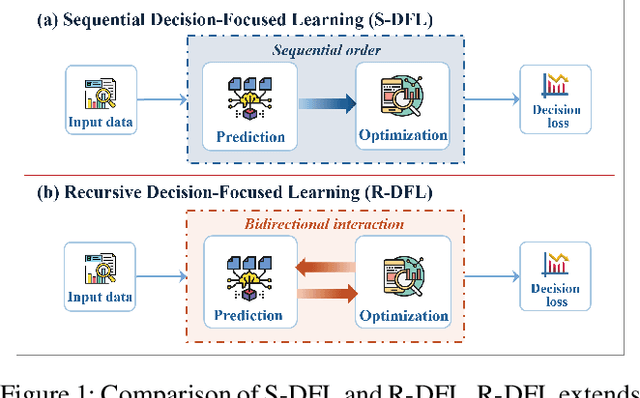
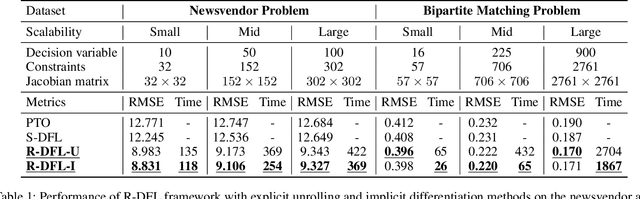
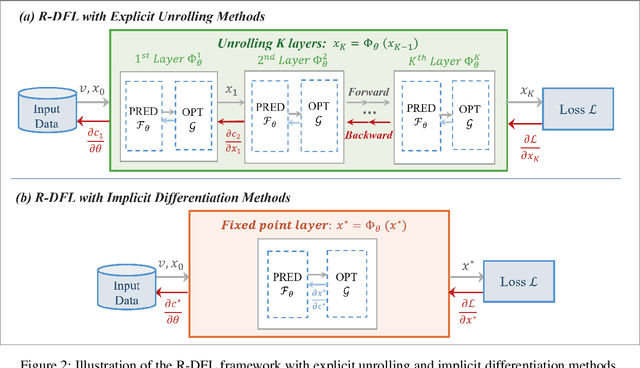
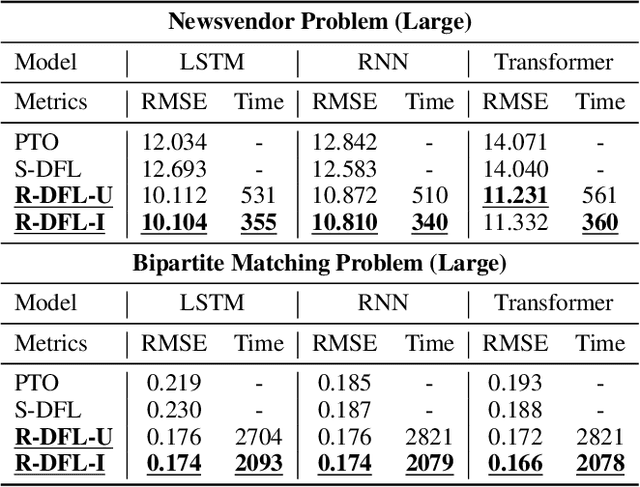
Decision-focused learning (DFL) has emerged as a powerful end-to-end alternative to conventional predict-then-optimize (PTO) pipelines by directly optimizing predictive models through downstream decision losses. Existing DFL frameworks are limited by their strictly sequential structure, referred to as sequential DFL (S-DFL). However, S-DFL fails to capture the bidirectional feedback between prediction and optimization in complex interaction scenarios. In view of this, we first time propose recursive decision-focused learning (R-DFL), a novel framework that introduces bidirectional feedback between downstream optimization and upstream prediction. We further extend two distinct differentiation methods: explicit unrolling via automatic differentiation and implicit differentiation based on fixed-point methods, to facilitate efficient gradient propagation in R-DFL. We rigorously prove that both methods achieve comparable gradient accuracy, with the implicit method offering superior computational efficiency. Extensive experiments on both synthetic and real-world datasets, including the newsvendor problem and the bipartite matching problem, demonstrate that R-DFL not only substantially enhances the final decision quality over sequential baselines but also exhibits robust adaptability across diverse scenarios in closed-loop decision-making problems.